Estelle Bennett died just the other day.
Some of you aren’t going to know who that is. Heck, most of you won’t. She wasn’t any grand dame of the publishing biz. She wasn’t some obscure Welsh writer known for talking animal stories. She wasn’t the stoic wife of a famously drunken crime writer. Estelle Bennett was a member of The Ronettes.
You know, The Ronettes: Be My Baby, Wall of Sound, beehive hairdos, all that good stuff? Now, I love me some girl group music. The Marvelettes, The Shirelles, The Crystals, The Supremes – I dig it all. Give me some harmonies and complicated backup vocals over a cheap sound system down at the local watering hole, and I’m happy as the proverbial clam.
You may rightly be wondering, Gothic Shoppers, what difference it could possibly make that I’m a Ronettes fan. This is a blog about books and bookselling, after all. But the thing is, (and you did know I’d make this work, didn’t you?) there’s a Ronettes book connection.
Let’s flash back to the Mesozoic Era: I’m fresh out of college, living in Texas, attempting (and failing) to turn a literary bookstore into a raging success, and inhabiting a rundown house with three other guys. We’re all broke, all the time, so all we ever do is read and talk. And listen to rock and roll. We pass books around and stay up late into the night discussing them as though they constitute Holy Scripture. There are rambling discussions of Thomas Pynchon, Jorge Luis Borges, Gertrude Stein, and (god help me) Derrida. But by far the most discussed book of that stretch of time is, hands-down, Be My Baby: How I survived Mascara, Miniskirts, and Madness or My Life as a Fabulous Ronette by Ronnie Spector with Vince Waldron.
We were obsessed with this book. This is no exaggeration. During the month or so that we took turns reading this now criminally out of print masterpiece, the house was flooded with the thundering, lush sound of the Ronettes’ music. We memorized passages from the book. We debated what the creepiest aspect of Ronnie’s relationship with the great (and twisted) producer Phil Spector was. We lived and breathed Ronnie Spector, her sister Estelle Bennett, and their cousin Nedra Talley.
I still love to read books on music, and there are plenty of killer titles out there. Geoff Dyer’s book on jazz, But Beautiful, is as elegant a piece of writing as you’re likely to find on any subject. In England’s Dreaming, Jon Savage drags punk rock history snarling and spitting through pre- and post- Thatcher Britain, forcing the reader to wonder who gave birth to whom. Durham’s own John Darnielle wrote a nifty little masterpiece for the 33&1/3 series, a novel about one troubled young man’s obsession with Black Sabbath. For that matter, George Pelecanos’ A Firing Offense and Sean Stewart’s Perfect Circle are as much about rock and roll as they are about crime and clairvoyance, respectively.
I could go on and on (and you’ll be surprised, I know, when I don’t) with such a list. But while each of these books is in its own way amazing, it’s been about a couple of decades since those Be My Baby days. I’m skeptical of hitting that level of fandom that I had back then. When you’re in your twenties, music matters in that particular, intense way that tends to mellow across the years. These days I’m more likely to enjoy a book on music for the skill of the writer rather than the appeal of his subject. Heck, I’ll even read about Randy Newman, if Greil Marcus is writing about him.
Still, whenever I hear the opening drumbeats of a good Ronettes song, I’m back in that crappy old house, sitting across a table from my best friends. One of us has the book open and is reading aloud from it. We’re all laughing.
It’s a good memory. Many thanks to the Ronettes. And rest in peace, Estelle.
Monday, February 16, 2009


Friday, February 13, 2009
Versus: Settings

This week for the Versus installment of the Gargoyle, Arthur and I are going to tackle fictional or mythical settings. We’ve been saving this one up, and I’m excited to see what Arthur comes up with. (Of course, our favorite actual setting is the Gothic Bookshop. Especially that nook under the Religion Sale Books table, which is where I like to nap…)
Arthur first:
Before I launch into a nice meaty chunk of why I picked the locale I did let me first address my criteria for a great book location. In my case, my location is fictional so the number one criterion for me is: is the place believable. Secondly, would be can I close my eyes and see the details the author describes to me. Thirdly, does the location fit within the greater scope of the book? Lastly, Is the location relevant to what is transpiring in the book?
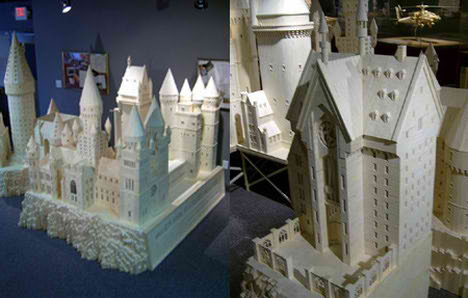
My favorite setting for a book is Hogwarts School of Witchcraft & Wizardry from J.K Rowling’s’ Harry Potter novels.
Is Hogwarts believable? I think so; after all it’s really just a castle on the outside. The English countryside is dotted with castles. Hogwarts is located in Scotland in the novels so a castle would hardly be a stretch for Scotland. Inside of Hogwarts there are all sort of magical things, paintings that talk, ghosts that walk, and moving staircases. These things would all be typical to find in a castle, especially a magical one.
Secondly, can I close my eyes and imagine the place? Absolutely, I daresay nearly everyone who read the Potter novels has a pretty clear image of Hogwarts. They may differ slightly but I believe they would overall be very similar. Deep down inside I believe a good book to be fuel for the imagination. Rowling does a wonderful job of painting Hogwarts almost as a living breathing entity. The best part is that Harry has never had a home that he felt comfortable and welcomed in. Then he arrives at Hogwarts and realizes that it is his home, and for the first time he feels wanted somewhere. Rowling uses the castle to cement the protagonist. It actual adds something to a character.
Thirdly, does Hogwarts fit in the grander scope of the Potter novels? Well we have schools for lawyers, doctors, and engineers, so why not a school for up and coming wizards and witches? If one is prepared to accept the premise of the novels, that witches and wizards exist. Then certainly one can understand the need for a place to teach them the craft. As the books go on we see Hogwarts importance grow, culminating in the final battles of the books taking place at the castle. In fact I would argue that well over 50% of the Potter books take place inside the castle.
Finally, is Hogwarts relevant to what is transpiring in the books? Well not to sound cliché’ (thanks Obama) but Hogwarts is a beacon of hope in the wizarding community. It is a school for the future of wizardkind. We know that other schools for magic exist but none are revered as highly as Hogwarts. Hogwarts becomes extraordinarily relevant when it becomes the host/home for the Boy who Survived, Harry Potter. Potter’s presence at Hogwarts, and subsequent growing love for the building, cement the place as a relevant, vital part of the books. We see this particularly in the book The Order of the Phoenix with the addition of the Room of Requirement. The room is an area of Hogwarts that becomes available whenever there is a great need for a place. The room becomes available to Harry as a place for him and his fellow students to practice their Defense against the Dark Arts. They are unable to do so normally because of a haggish teacher named Professor Umbridge. Harry states in the book that it is almost as though Hogwarts were helping them fight back by providing them with the room as a place to train.
In closing, there are so many more things I could touch on, which in and of itself is a testimony to how viable a pick I feel this location is.
Now Bill:
Arthur, I’m totally with you on your pick. No fictional setting has absorbed me as much as Hogwarts, not since I was a kid and reading about Sherwood Forest or Middle Earth or the House of Usher. I think I may go a little more abstract, though.
You guys are going to think I’m taking the easy way out, but I’m gonna have to go with The Garden of Eden for my Best-Setting Versus pick today. Think about it. Whether you’re a biblical literalist or a reader who’s inclined to treat Adam & Eve’s backyard as something closer to a mythical ideal, you’re affected by the notion of Paradise. (And I hope I'm not offending anyone by calling Paradise a mythical setting; for the sake of this installment of Versus, I'm treating the Bible purely as a literary text)
When Arthur and I decided on settings for our Versus topic this week, a cascade of ideas ran through my head: Yoknapatawpha, Narnia, Macondo, the futuristic dystopia of Orwell’s 1984, Superman’s Metropolis. It kind of made me dizzy until I realized that each of these settings are defined by the degree to which they resemble or diverge from the notion of utopia.
So where do we get the notion that there is any state of perfection towards which we can strive? What begets the dissatisfaction that we humans feel when all is not right? I’m going to say that we can lay the responsibility, if not the blame, on the book of Genesis and its notion that there was once an environmental manifestation of perfection.
We don’t have a whole lot to go on for a physical description of Paradise, but for generations we’ve been undeniably affected, addled, and inspired by the idea of it.
So that’s my pick, and we’ll see you next week, Gothic Shoppers.
Wednesday, February 11, 2009
Speaking of pet peeves….
I’m not sure actually that this is a pet peeve. It may just be a peeve, but for me, it’s a big one. Amazon has announced it will soon be bringing out the Kindle 2, an updated version of their electronic book reader. Now, I don’t object to the Kindle in general. I will probably never use one because I like to see, feel, and smell books too much to give the actual thing up, but I understand the desire to be able to carry around many books without carrying the actual books. What I do object to is that books for the Kindle are only available from Amazon. Why isn’t this restraint of trade? Why do publishers go along with this? Why does Indie Next (the independent bookstore wing of the American Booksellers Association) not bring their collective weight to bear on publishers about this? We can sell regular e-books from our website, why not Kindle format titles? AND NOW, on top of this, Stephen King has agreed to write a short story that will be available only in Kindle format for the launch of the new Kindle. How could he?? Apparently he doesn’t remember what it was like to be an unknown. Only a few writers ever become a commercial success and of those, rarely does one ever become known because of Amazon. They become known because people who work in independent bookstores read their books, like them and get them in the hands of other readers. After all that, then they might end up being a good deal on Amazon.
Okay, I’m done. Not a big rant, but I haven’t had enough caffeine and I have lots of returns to do. Tempted though I may be, I won’t send back all of our Stephen King....
Okay, I’m done. Not a big rant, but I haven’t had enough caffeine and I have lots of returns to do. Tempted though I may be, I won’t send back all of our Stephen King....
Monday, February 9, 2009
Trans-Nation Boogie
Welcome to Monday, Gothic Shoppers. Like many of you, I’m not normally inclined to celebrate the first day of the working week, but given that seven days ago I completely spaced out on what day it was and failed to turn in my weekly blog post, I’m happy just to be slightly more on the ball this week.
I should warn you right now that we’re in for one of those sprawling, directionless rambles that I occasionally turn in. It’s a beautiful day; my supplier next door has me on the way to being fully wired, and I’ve got a couple of notions that have been kicking around in my head for a while. I think it’s time to throw them at the wall and see if they turn into anything coherent (unlikely, I know).
What’s up is that I went to hear some incredible jazz about a week ago, and the shortlist for the best translated book award has been announced. You get where I’m going with this, right? No? Well, I can’t be sure myself, but let’s see what happens.
First things first: It’s the twenty-fifth anniversary of the Mary Lou Williams Center for Black Culture, and we at the Gothic Bookshop want to offer our congratulations and gratitude to its staff. In addition to the many services that it offers Duke Students, the Center brings excellent jazz to campus, in keeping with the spirit of its namesake. We’re lucky to have them here on campus.
As part of its anniversary celebration, the MLW Center, in conjunction with Duke Performances, hosted the great pianist Geri Allen for a performance of Mary Lou Williams’ Zodiac Suite. My friend Stompy Jones and I made the scene, and I kid you not when I say that this was one of the most exciting jazz shows I’ve seen in a good long time. It was fascinating to watch a performer at her peak bring her talent to bear on an extended piece written by another composer.
When a jazz musician such as Allen takes on a piece by another artist, her goal is to honor the original composition while making the piece a vehicle for her own voice. No two musicians will perform the same piece in an identical manner, and in fact no two performances of that piece by the same musician will be alike. This is how an older standard such as Mary Lou Williams’ Hesitation Boogie stays alive: by being constantly, subtly altered.
Is the same true in the literary world? Certainly there are multiple English translations of almost every classic text, but is the goal of a translator, like that of a jazz artist, to use the text as a vehicle for his own stylings? I’m going to have to say no. A translator’s job, ideally, is not to reinvent a text, but to keep its translation as close as possible to the spirit of the original. And the driving reason behind a new translation of a work is (or should be) a renewed attempt to get the thing right.
Now, that’s not to say that it isn’t entertaining to watch a translator go off the reservation once in a while. One of my favorite translated-lit memories is of coming across a passage in Federico Garcia Lorca’s beautiful book, Poet in New York. In the poem The King of Harlem, there’s a very simple line: Hay que huir. Now, literally this means we must flee, or one should flee. The Simon & White translation, however, has this line translated as there must be some way out of here (!!). I’m sorry, was someone a little distracted by the copy of John Wesley Hardin playing in the background? How did a Dylan lyric make its way into a Lorca poem? Or had Dylan been browsing a little Lorca when he sat down to write All Along The Watchtower? Maybe it's a private joke on the part of the translator, a tip of the hat to Bob's well-known familiarity with Lorca. I love thinking about this kind of stuff (Yes, Gothic Shoppers, I’m a geek, but you knew that already).
Weirdo exceptions aside, translations of books from other countries offer us the chance to understand, even experience, other cultures from our remote vantage point. For this reason above all others, though the translator’s role in the world of books is paramount, he must remain as invisible as possible, so as not to block the bridge he’s attempting to build.
That bridge to other cultures is something we’re dedicated to maintaining here at the Gothic. Whether it’s a book written in English right here in Durham, or any one of the broad selection of translated works we’ve got on the shelves, we like to think that we offer myriad jumping-off points for a reader to go outside his or her own experience.
So come in and browse, or let us recommend a good translated work to you. Then when you get home, slap Geri Allen’s Zodiac Suite Revisited on the stereo for some background music while you cross that bridge.
I should warn you right now that we’re in for one of those sprawling, directionless rambles that I occasionally turn in. It’s a beautiful day; my supplier next door has me on the way to being fully wired, and I’ve got a couple of notions that have been kicking around in my head for a while. I think it’s time to throw them at the wall and see if they turn into anything coherent (unlikely, I know).
What’s up is that I went to hear some incredible jazz about a week ago, and the shortlist for the best translated book award has been announced. You get where I’m going with this, right? No? Well, I can’t be sure myself, but let’s see what happens.
First things first: It’s the twenty-fifth anniversary of the Mary Lou Williams Center for Black Culture, and we at the Gothic Bookshop want to offer our congratulations and gratitude to its staff. In addition to the many services that it offers Duke Students, the Center brings excellent jazz to campus, in keeping with the spirit of its namesake. We’re lucky to have them here on campus.
As part of its anniversary celebration, the MLW Center, in conjunction with Duke Performances, hosted the great pianist Geri Allen for a performance of Mary Lou Williams’ Zodiac Suite. My friend Stompy Jones and I made the scene, and I kid you not when I say that this was one of the most exciting jazz shows I’ve seen in a good long time. It was fascinating to watch a performer at her peak bring her talent to bear on an extended piece written by another composer.
When a jazz musician such as Allen takes on a piece by another artist, her goal is to honor the original composition while making the piece a vehicle for her own voice. No two musicians will perform the same piece in an identical manner, and in fact no two performances of that piece by the same musician will be alike. This is how an older standard such as Mary Lou Williams’ Hesitation Boogie stays alive: by being constantly, subtly altered.
Is the same true in the literary world? Certainly there are multiple English translations of almost every classic text, but is the goal of a translator, like that of a jazz artist, to use the text as a vehicle for his own stylings? I’m going to have to say no. A translator’s job, ideally, is not to reinvent a text, but to keep its translation as close as possible to the spirit of the original. And the driving reason behind a new translation of a work is (or should be) a renewed attempt to get the thing right.
Now, that’s not to say that it isn’t entertaining to watch a translator go off the reservation once in a while. One of my favorite translated-lit memories is of coming across a passage in Federico Garcia Lorca’s beautiful book, Poet in New York. In the poem The King of Harlem, there’s a very simple line: Hay que huir. Now, literally this means we must flee, or one should flee. The Simon & White translation, however, has this line translated as there must be some way out of here (!!). I’m sorry, was someone a little distracted by the copy of John Wesley Hardin playing in the background? How did a Dylan lyric make its way into a Lorca poem? Or had Dylan been browsing a little Lorca when he sat down to write All Along The Watchtower? Maybe it's a private joke on the part of the translator, a tip of the hat to Bob's well-known familiarity with Lorca. I love thinking about this kind of stuff (Yes, Gothic Shoppers, I’m a geek, but you knew that already).
Weirdo exceptions aside, translations of books from other countries offer us the chance to understand, even experience, other cultures from our remote vantage point. For this reason above all others, though the translator’s role in the world of books is paramount, he must remain as invisible as possible, so as not to block the bridge he’s attempting to build.
That bridge to other cultures is something we’re dedicated to maintaining here at the Gothic. Whether it’s a book written in English right here in Durham, or any one of the broad selection of translated works we’ve got on the shelves, we like to think that we offer myriad jumping-off points for a reader to go outside his or her own experience.
So come in and browse, or let us recommend a good translated work to you. Then when you get home, slap Geri Allen’s Zodiac Suite Revisited on the stereo for some background music while you cross that bridge.
Tuesday, February 3, 2009
The Road Less Peeved
So, I have a couple of pet peeves when it comes to what I read. If I start reading a book at it becomes apparent that any of these peeves are present it makes the book tons easier to put down. Now before you lambaste me for quitting so easily let me tell you that in general I am a very forgiving reader. You have to go out of your way to lose me but some books go above and beyond.
Just the other day I picked up a new read from our hardcover fiction section entitled Beat the Reaper. The book had garnered pretty good word of mouth. It was a Booksense recommended title. I opened it and started reading; within the first 15 pages it had broken at least 3 of my peeves in half.
Let me amend this post to include a warning:
1- Swearing un-profoundly: I do not like it when an author seems to include a ton of swear words. By and large I think of swear words as weak writing. I believe an author turns to swear words when they lack the imagination to come up with anything else to say. This does not mean I’m against an occasional swear word. I believe that when used properly a swear word can have huge impact. Especially, when said swear word is out of place or character. It can emphasize how much a character is struggling with a situation or person. When every other word out of a characters mouth is a swear word, they lose any impact they ever could have had. A second reason a writer turns to swear words is to appear edgy. Much like why teenagers swear these days, so they can appear cool to their friends, an author might turn to swear words to appear cutting edge or noirish. I'm all for returning the impact to a good swear word by adopting the less is more attitude.
2- Footnotes: If I wanted to read footnotes I would choose a scholarly text. I especially hate it when the author uses footnotes to try an add humor to the novel. Why not add the humor to the actual book instead. As I explained earlier, just breaking a single one of my peeves is not crime enough to stop me from reading a book, and there is a prime example here. The book Good Omens by Neil Gaiman and Terry Pratchett contains footnotes and I plowed through them and still can highly recommend the book. To me footnotes can add little to the story and distracts me from the actual plot of the novel.
3- Stereotypical Cookie Cutter Characters: The number one offender of this too me is the loose woman. I have read books with women as the heroines, the villains, the partner, the victim, and the professor but I really cannot stand it when without any rhyme or reason a female character is included to give a man something to do (and by that I mean sexually) These are throw away characters that add nothing to a plot. They are merely used again to show a character as a womanizer or to appear edgy again (see #1). Characters in general deserve more than stereotypes. The black rapper, the Italian gangster, the prostitute with a heart of gold, the elf archer, or the cannibalistic serial killer, they all deserve better classifications. When an author includes a character in a story is it too much to ask that they be fleshed out and somewhat original?
When I started thinking of writing a book a few years back (yes I’m still writing it). I bought a book entitled Building Believable Characters. It is a great book that helps you build a characters back-story up so that when they appear in your novel you can figure out how they would react to a plot device by just looking at it. It is a fantastic book and a must read for any aspiring author.
Well those are my pet peeves and I know many of you may not share mine, agree with me on some but not others, or just have radically different ones. Feel free to let me know what yours are because complaining is fun.
Subscribe to:
Posts (Atom)