Showing posts with label Versus. Show all posts

Friday, February 13, 2009

Versus: Settings


This week for the Versus installment of the Gargoyle, Arthur and I are going to tackle fictional or mythical settings. We’ve been saving this one up, and I’m excited to see what Arthur comes up with. (Of course, our favorite actual setting is the Gothic Bookshop. Especially that nook under the Religion Sale Books table, which is where I like to nap…)

Arthur first:

Before I launch into a nice meaty chunk of why I picked the locale I did let me first address my criteria for a great book location. In my case, my location is fictional so the number one criterion for me is: is the place believable. Secondly, would be can I close my eyes and see the details the author describes to me. Thirdly, does the location fit within the greater scope of the book? Lastly, Is the location relevant to what is transpiring in the book?

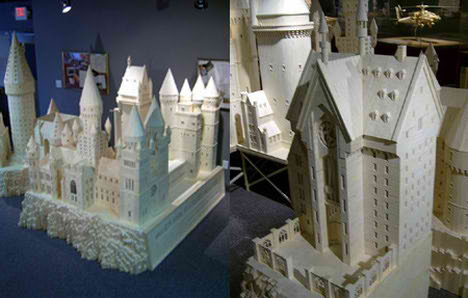
My favorite setting for a book is Hogwarts School of Witchcraft & Wizardry from J.K Rowling’s’ Harry Potter novels.

Is Hogwarts believable? I think so; after all it’s really just a castle on the outside. The English countryside is dotted with castles. Hogwarts is located in Scotland in the novels so a castle would hardly be a stretch for Scotland. Inside of Hogwarts there are all sort of magical things, paintings that talk, ghosts that walk, and moving staircases. These things would all be typical to find in a castle, especially a magical one.

Secondly, can I close my eyes and imagine the place? Absolutely, I daresay nearly everyone who read the Potter novels has a pretty clear image of Hogwarts. They may differ slightly but I believe they would overall be very similar. Deep down inside I believe a good book to be fuel for the imagination. Rowling does a wonderful job of painting Hogwarts almost as a living breathing entity. The best part is that Harry has never had a home that he felt comfortable and welcomed in. Then he arrives at Hogwarts and realizes that it is his home, and for the first time he feels wanted somewhere. Rowling uses the castle to cement the protagonist. It actual adds something to a character.

Thirdly, does Hogwarts fit in the grander scope of the Potter novels? Well we have schools for lawyers, doctors, and engineers, so why not a school for up and coming wizards and witches? If one is prepared to accept the premise of the novels, that witches and wizards exist. Then certainly one can understand the need for a place to teach them the craft. As the books go on we see Hogwarts importance grow, culminating in the final battles of the books taking place at the castle. In fact I would argue that well over 50% of the Potter books take place inside the castle.

Finally, is Hogwarts relevant to what is transpiring in the books? Well not to sound cliché’ (thanks Obama) but Hogwarts is a beacon of hope in the wizarding community. It is a school for the future of wizardkind. We know that other schools for magic exist but none are revered as highly as Hogwarts. Hogwarts becomes extraordinarily relevant when it becomes the host/home for the Boy who Survived, Harry Potter. Potter’s presence at Hogwarts, and subsequent growing love for the building, cement the place as a relevant, vital part of the books. We see this particularly in the book The Order of the Phoenix with the addition of the Room of Requirement. The room is an area of Hogwarts that becomes available whenever there is a great need for a place. The room becomes available to Harry as a place for him and his fellow students to practice their Defense against the Dark Arts. They are unable to do so normally because of a haggish teacher named Professor Umbridge. Harry states in the book that it is almost as though Hogwarts were helping them fight back by providing them with the room as a place to train.

In closing, there are so many more things I could touch on, which in and of itself is a testimony to how viable a pick I feel this location is.


Now Bill:

Arthur, I’m totally with you on your pick. No fictional setting has absorbed me as much as Hogwarts, not since I was a kid and reading about Sherwood Forest or Middle Earth or the House of Usher. I think I may go a little more abstract, though.

You guys are going to think I’m taking the easy way out, but I’m gonna have to go with The Garden of Eden for my Best-Setting Versus pick today. Think about it. Whether you’re a biblical literalist or a reader who’s inclined to treat Adam & Eve’s backyard as something closer to a mythical ideal, you’re affected by the notion of Paradise. (And I hope I'm not offending anyone by calling Paradise a mythical setting; for the sake of this installment of Versus, I'm treating the Bible purely as a literary text)

When Arthur and I decided on settings for our Versus topic this week, a cascade of ideas ran through my head: Yoknapatawpha, Narnia, Macondo, the futuristic dystopia of Orwell’s 1984, Superman’s Metropolis. It kind of made me dizzy until I realized that each of these settings are defined by the degree to which they resemble or diverge from the notion of utopia.

So where do we get the notion that there is any state of perfection towards which we can strive? What begets the dissatisfaction that we humans feel when all is not right? I’m going to say that we can lay the responsibility, if not the blame, on the book of Genesis and its notion that there was once an environmental manifestation of perfection.

We don’t have a whole lot to go on for a physical description of Paradise, but for generations we’ve been undeniably affected, addled, and inspired by the idea of it.

So that’s my pick, and we’ll see you next week, Gothic Shoppers.

Thursday, January 15, 2009

Versus: Heroes and Villains


Here’s the thing about the Best Fictional Hero and Best Fictional Villain categories: you’ve got to choose from a range of figures that are larger than life. These aren’t normal characters. Harry Potter isn’t just some dude at a boarding school; Dracula is more than an aging aristocrat with yen for bloody marys. These are Heroes, man. Villains. There has to be some quality that sets them apart.

It’s tempting to identify a certain set of abilities (e.g. super-strength, magic, the ability to consume an impossibly large plate of nachos at one sitting) as the defining element of the hero. I think, though, that it’s a willingness to do what other men or women won’t that makes for a hero. I mean, if Wonder Woman didn’t use her butt-kicking skills & magic lariat to fight crime, she’d just be some lady in a bathing suit, am I right?

Villains are tricky. An awful lot of them, including some of the best, follow the formula H + F = BBV. (That’s Hero + Flaw = Bad, Bad Villain.) Voldemort, one of the most memorable villains of the last ten years or so, is a powerful wizard much like Albus Dumbledore. Unlike ol’ AD, however, Voldemort has a singular obsession that edges him out of the “good guys” column and into the “attack on sight” column: he’s terrified of death, and he’ll do anything to anyone in order to avoid it. Sherlock Holmes’ nemesis, Professor Moriarty, is very much Holmes’ mental twin, save for what A. C. Doyle describes as “a criminal strain [that] ran in his blood.” But there are those villains who need no inverse twin. Hannibal Lecter, one of the classic villains, is moved by his own internal sense of right and wrong and needs no white knight to motivate him.

Aaaaanyway. I’m starting to ramble (again). Today’s “Versus” installment is about heroes and villains, obviously. As I look over Arthur’s and my picks, I see that we’ve once again done practically the opposite of each other. Arthur’s pick for Best Villain is thoroughly larger than life; His Best Hero pick is a character who lives in the shadow of the story's canonized hero. I’ve gone the other way, as you’ll see. It makes one wonder if Arthur and I might be nemeses. But who is the hero, and who is the villain? Only time will tell…

(Arthur, you go first.)

ARTHUR:

My VILLAIN is a character from the Song of Ice and Fire series named Tywin Lannister. Tywin is the patriarch of the Lannister family. The Lannisters are one of the wealthiest families in the world at the time of the novels. Tywin is rarely seen in A Game of Thrones or A Clash of Kings but we learn about him heavily through the actions of his progeny, Jaime, Cersei, and Tyrion. Jaime is the golden boy of the family, the pride of his daddy’s eyes. He has been groomed from a young age to take the family over and I believe he secretly wants Tywin to die so that he can do so. When the books begin he is embroiled in a secret incestuous affair with his sister Cersei. Cersei is the female equivalent of Jaime. She is totally ruthless and uses her sex and attractiveness to manipulate men, including Jaime. Their incestuous affair eventually leads to Cersei telling Jaime to through a young man off the side of a tower because he saw them together. Where Jaime is brawn and Cersei manipulative, neither is as clever or quick witted as Tywin's bastard dwarf son, Tyrion. Tyrion is nowhere near as evil as his siblings. He has led a life of being a bastard and it has caused him to become hardened. His aloneness has however led him to becoming sly. He understands things at a deeper level than his siblings. In many ways he is more like Tywin than the others. Tywin rarely acts on his own preferring to manipulate his children or underlings to do his dirty work. Nonetheless the dirty work is real dirty. He orders Cersei to seduce the king thereby becoming the queen so as to further his own goals. Jaime was ordered to kill the former king because he disliked Tywin. Tywin reign of terror ends in the books, killed by his own son, Tyrion. In the end, Tywin wrought what he sowed.


Samwise Gamgee from The Lord of the Rings is my HERO of choice. The very first time we meet Samwise, we only know him as a friend of Frodo. That is really all we need to know about him, it is what lies at the very heart of Sam, friendship. It is the reason he travels to the very pit of Mount Doom with Frodo. Sam never sees himself as a hero. He is one of the few people the ring has no effect on. I believe it’s because at his very heart there was no desire for the ring to manipulate. He never sought out attention or fame. Throughout the travel Sam never loses track of who he is. He is one of the only hobbits who express a desire to go home. Sam sees protecting Frodo as his duty, not to the world or a higher power, but as Frodo’s friend. Sam is first foremost and forever a friend. Samwise stares into the heart of evil repeatedly and does it all for no gain of his own. Even after the ring is gone he tries desperately to help Frodo hold on to reality. He is a consummate friend and that makes him heroic to me.

BILL:

My VILLAIN of choice is Montresor, from Poe’s story The Cask of Amontillado. Montresor is a small man, driven to murder by nothing more than a profound dislike of a man and an desire to avenge what he perceives to be an insult to his (Montresor’s) character. Poe excelled at creating such characters—driven by greed, pride, and above all madness to commit acts of revenge and torture. Montresor describes his seduction of his victim and his method of murder (no spoilers here) in a detached but harrowing style that has haunted me since I read the book as a kid. He’s cold, he’s ruthless, and he’s got nothing more than mere pettiness driving him to murder. In creating such a small villain, Poe managed to convince a very young reader that evil doesn’t always announce itself with a dark cape and a corny one-liner.

I guess I was very taken with good guys and bad guys as a kid, because I went back to my childhood for my HERO pick as well. I’m going with Robin Hood. Specifically, I’m going with Howard Pyle’s Robin Hood. He’s an outlaw, but only because some really bad dudes are running things. He’s a thief, but he gives all (well, most) of his loot to the poor. After barely escaping from the law, he and his men like to kick back and sing songs and eat and drink. The notion of stealing from the rich and giving to the poor really resonated with me as a kid. (It’s probably why I’m a Democrat today, but let’s not get into that right now…) More than anything, Robin Hood represented a life that was so far away from mine, so remote from my own experience, that I could believe everything I read about him. When I read Pyle’s Robin Hood as an adult (and I do, often), it of course seems in some ways exaggerated and silly. But to the ten-year-old me, Robin Hood was grand, and tough, and true, and believeable.