Monday, June 22, 2009

Versus: Monster Blog!!


Pride and Prejudice and Zombies: maybe you’ve heard of it. It’s been a national, runaway sensation. There have been news stories, reviews and editorials on the book. It is far and away our bestselling title, whenever we’ve been able to keep it in stock, that is. . It’s truly shaping up to be the book of the summer, against all odds.

Well, I say “against all odds”, but that’s not really true. In fact, the odds were solidly in the book’s favor. For any of you who’ve been living under a rock or who in fact are zombies yourselves, let me present the basic concept: it’s the plot of Jane Austen’s Pride and Prejudice, with scenes inserted in which the characters try to fight off zombies. There. It’s simple, isn’t it? Simple, and flat-out brilliant. The brainchild behind the project, Seth Grahame-Smith, is lurching & staggering all the way to the bank. His fingers are falling off as he counts his money.

Why? Because monsters are hot right now. Zombies are all over the place, that’s for sure. Max Brooks’ World War Z has been a big seller for us, especially since Arthur had it as a staff pick last month. There’s the Zombie Survival Guide, the Zen of Zombie, Zombie Blondes, and Never Slow Dance With a Zombie. For my money, the best of the lot can be found in Kelly Link’s book Magic for Beginners, in which her story, The Hortlak describes a convenience store at the edge of the world in which zombies shop for things that don’t exist. But then I’m something of a Kelly Link nut.

It’s not just zombies that have overrun the book world. We’ve got yetis, Bigfoot, Werewolves—you name it. And we can’t forget the hottest of all hot monsters, the vampire.

Not since Harry Potter came on the scene has there been such a breakout book for young readers as Stephanie Meyer’s Twilight. That title and Meyer’s subsequent books -New Moon, Eclipse and Breaking Dawn- have been huge bestsellers, spawning a hit movie with sequels to come.

The monster-driven riches that authors like Meyer and Grahame-Smith are rolling in have gotten Arthur and me thinking about what the next hot (or hott) monster will be. We want in on this. We had a conversation with one of our Schokenly intelligent customers recently. She agreed with us that werewolves are up and coming, but thought there was probably room for the faerie folk to make a comeback. Arthur and I think that she’s the one to write it, so watch out for that somewhere down the line.

As for Arthur and me, we have slightly diverging opinions (as always) on what will be the next big sexy scary. So we’re doing an installment of Versus today. It’s a scare-off!

You first, Arthur:


ARTHUR:

Before I roll out my mythical pick for you I thought I might touch on what I feel are some points that make for a great mythical archetype.

1) Must Appear Human: vampires, werewolves, and even zombies to a degree can appear human at times. It would be difficult for a storyteller to weave a compelling tell about a monster who was always monstrous. Humanity is one of the few things that all of an author’s reader will have in common. Humanity also makes for an interesting plot point. The monsters desire to return to mere humanity. It is what drove the television series Angel.

2) Love: You are much more likely to be interested in something if there is a potential for a love story to be told. I would argue that Twilight is a love story, which just happens to include vampires. We are suckers (no pun intended vamps) for a good love story.

3) Mythos: any good mythical monster comes with a mythos, some larger than others. The larger the mythos the harder the job for the writer. Do you lock yourself into the existing mythos or forge ahead a slightly altered mythos at the risk of offending others?

I have decided on a “monster” that can appear human from time to time. This allows him/her to build relationships with humans and even love them. I chose a monster with a limited mythos so a new fresh one could be rolled out without traumatizing too many followers.

Insert drum roll here

My selection is the Djinn, or genie as we call them from time to time. The Djinn for all intents and purposes is a human who has been granted the rights to make wishes happen.

Several questions come about when thinking of this:

1) Why the lamp? First thing I would do would be to ditch the lamp. I would spin this into a different story. Lets say the Djinn’s spirit is contained with a vessel of some sort, not necessarily a lamp. The Djinn would need to be in constant vigilance over the whereabouts of their spirit vessel.

2) What about the wishes? I think a lot can be done here. Imagine a Djinn who has existed for eons. He has done both good and bad things. He is traumatized by the bad and desires only to do the good. He is at his deepest a good person who wishes to improve people’s lives. (See what I did there? He’s a genie that wishes something for himself. The depth of humanity there.)

3) Where’s the love? Through chance or luck our djinn's spirit vessel ends up in the possession of the most thoughtful woman he has ever met. He desires to stay with her forever but he knows there is a limit to what he can do. He is bound by magic older than himself. What if she desires to stay with him too but understands the condition he is in? They could try to unravel the mysteries surrounding what it means to be a Djinn together.

4) Finally, Where’s the plot? The plot is in the discovery. How did djinns come to be? Who are these people who are now djinns? How did their spirits become tied to these vessels? How or can they ever be free again?

Ladies and gentlemen, that’s it for me. I think the idea is fascinating but maybe I’m in the minority here. Either way I can’t wait to see what Bill’s got cooking:

BILL:

Arthur, that’s a very well thought-out take on the monster novel. I’m totally with you on the Djinn. I wish I could promise the same degree of insight with my pick. I do have a monster in mind, though I have no delusions that my choice is likely to catch on. Out of respect for your thoughtful choice, I’m going to try to get down a few notions of my own regarding what we can call the MLS (Monster Love Story):

1) I’ll take your notion of the monster/human one step further. I agree that a humanoid or even part-time human monster makes for a good story (and especially good film rights- let’s not forget the riches we’re after). But what I think makes a monster appealing is his/her/its reflection of some aspect of the human condition: the vampire is a lonely creature who hides from the light; the werewolf periodically loses control of his animal nature; the yeti… smells bad. It’s what we see in monsters and recognize in ourselves (or wish we did) that makes them alive and enticing to us.

2) Monster love is, ultimately, impossible love. You referred to the TV series Angel earlier (and I will bring you those DVD’s back, honest). I’ll also invoke Twilight here. Both stories feature love that cannot and must not be consummated. The most successful monster/human love stories bring the reader into contact with something dangerous without asking that he (or, more likely, she) commit to something dangerous.

3) The monster must be mortal. This is crucial. And not only mortal, but flawed in some way that makes him more vulnerable than even a human. The vampire is killed by a wooden stake; the werewolf is killed by a silver bullet; the yeti… I don’t know, the yeti dies from breathing his own stench. This of course introduces a measure of fragility to our monster, but more importantly it brings the threat of death. Let’s not forget that these MLS’s are ultimately about temptation and transgression. Nothing like almost certain death to give characters the permission to go walking on the wild side.

So, without further ado, here’s my pick for next year’s hot monster:

fanfare, please


It’s The Blob.

You heard me, The Blob. The Blob is the next great heartthrob. Or heartblob, as it were. Just bear with me. I can back it up using my own three rules:

1. The Blob embodies (sort of –he’s got no body) many aspects of the human condition, especially the adolescent condition: he’s an outsider, picked on because of his size; he’s an out-of-towner (well, an out-of-spacer) who doesn’t know anybody in his new school; he’s afflicted by that social disease that so many adolescents suffer from: mindless, endless consumption.

2. Is there any love more impossible than human/blob love? Beyond the inter-species difficulty, it’s clear that The Blob, in the rush of emotion and/or hunger of new romance, would absolutely smother a girlfriend.

3. Despite poor Blob’s massive size and unquenchable appetite, he’s just so fragile. He’s in terrible health—one hard winter will absolutely kill him.

So there you have it, Gothic Shoppers. Arthur and I have each set forth our picks for the hot monster to come. Feel free to leave a comment endorsing one or the other of the two plans (I’ll go ahead and concede victory to Arthur right now), or let us know what sexy beast you see slouching across the horizon.

Friday, April 24, 2009


It's a good day, Gothic Shoppers.

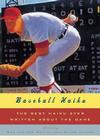
Way back when we first got started with this here blog-type-thing, I posted on those bookselling moments that make it all worthwhile. Just a few of those moments every couple of months can get a bookseller through a good long stretch of the doldrums. I bring this up now, because –shockingly—a customer just bought our last copy of Baseball Haiku.

Don’t panic, though. We’re ordering more.

At a former bookselling job, I was roundly mocked for suggesting this fine anthology as “the perfect holiday gift for fans of sports and poetry,” as though such a creature had not yet been invented. In the defense of my colleagues, total sales of the book came to a big fat goose egg. But I never lost hope in that little book. It seemed like a perfect idea. Baseball is a game that, for both spectator and player (well, outfielder, at least), provides ample opportunity for contemplation. Between concentrated bursts of action are periods of near stillness that can seem timeless. What better art form to capture such an atmosphere than haiku, poetry that draws heavily on a sense of stillness within the natural world?

Anyway, we’ve sold the heck out of those suckers.

As soon as it starts getting warm I get excited about going to baseball games. I won’t lie to you, Gothic Shoppers: no one who knows me even a little would confuse me with a die-hard sports fan. I just don’t have a brain for it. But I like baseball. I like its sounds and its pace and its place in the mythology of our country. And its hot dogs and beer.

I also really love baseball novels.

Baseball is by far the sport that gets the most representation in the world of fiction. I’m not sure why this is, though our understanding of it as America’s Game must have something to do with it. Perhaps it’s that contemplative pace that I was alluding to before (golf runs a close second to baseball in the world of fiction). Certainly the structure of a ball game lends itself to written description. Try, on the other hand, writing a chapter than contains a shot-by-shot description of a game between the Blue Devils and the Tar Heels. Your fingers would fall off.

This is not to say that there haven’t been great novels written on other sports. Don Delillo, for example, gave us End Zone, a brilliant postmodern novel about a college football team, and Dan Jenkins’ Semi-Tough is a funny-as-all-get-out story of an epic Super Bowl game. Gothic favorite Nick Hornby’s book, Fever Pitch –weirdly made into an american baseball movie—is now considered a classic of soccer (sorry, football) writing. Boxing been represented in any number of great novels, most significantly Leonard Gardner’s Fat City.

But lest I get off on a tangent, I’ll bring this post back to baseball novels and my fondness for them. The genre has some classics: Bang the Drum Slowly, Shoeless Joe, The Natural. But my favorites have been those odd, lesser-known titles –the ones that have come out of (I really am sorry about this) left field. Here are a few:

The Dixie Association, by Donald Hays – a great southern yarn about an Arkansan minor-league team, owned by a one-armed socialist and populated by ex-cons, American Indians, Cuban communists, and women. This could be your most fun read of the summer.

The Seventh Babe by Jerome Charyn – Charyn is one of those great American writers who has gone almost completely unnoticed by the reading public. In Seventh Babe, Charyn gives us a baseball story that resembles nothing so much as a medieval legend. We follow the ascent and downfall of a Jewish third basemen –Babe Ragland—through a crazy season with the 1923 Red Sox. (One reader who has noticed Charyn is Michael Chabon. If you liked Chabon’s last novel, The Yiddish Policemen’s Union, do yourself a favor and read some Charyn.)

Season’s End by Tom Grimes – Set in the malaise of the late seventies and leading up to the players’ strike of ’81, Grimes’ novel is a bittersweet tale of baseball success amidst the escalating greed and racism of that time. It’s a great read, as much for the fan of classic American fiction as for the baseball fan.

The Brothers K
by David James Duncan – Those who know Duncan’s work are passionate evangelists for it. His novel The River Why is considered, along with A River Runs Through It, to be the very epitome of the fly-fishing novel. Brothers K is one of those great, sprawling American family sagas. Against the backdrop of our country's Vietnam-era turbulence, the Chance family struggles to reconcile its two driving forces: religious fundamentalism and a love for baseball. It’s a moving and often funny book, and of course there’s a comeback-kid story to follow, as there should be in all baseball literature.

I could go on and on about this (as you all well know by now). But it’s a sunny day out there, and you Gothic Shoppers need to shut off the computer and get outside. First, though, swing by the store and pick up a copy of Baseball Haiku to take with you to a Bulls game. As I recently found out, though, there are no home games this weekend. You’ll have to wait until next Tuesday. Until then:

Blinding spring sun:
Upturned faces
Wonder where the fly ball went.

Thursday, April 9, 2009

In Memoriam: Dave Arneson


I just want to echo the sentiments in this link. I’m not sure how my life would have panned out if it were not for the systems this man created. It is hard for me to imagine a world without RPG’s in it. The sad thing is to many his death will go unnoticed. Many people think RPG’s have nothing to do with their existence, and for many they might not. But, if you’ve ever played an RPG of any type, played a MMORPG, or enjoyed the feel of an RPG on your next generation gaming system then this man was responsible for helping define it.

Some may argue that the Monster Manual or the D&D Rules Book don’t constitute reading a book. I beg to differ those books are equal parts story and textbook, and in a way more difficult to get through than a regular book.

In closing, this man created the skeleton on which all RPG’s are forged today and for that I honor his passing.

Tuesday, April 7, 2009

Like, Wao!

Hi again, folks.

Many of you have probably already heard that the summer reading for the incoming class of 2013 is Junot Diaz's book The Brief Wondrous Life of Oscar Wao. The book was chosen from an excellent list of finalists, but I will now freely admit that I was pulling for this title all along. It's a challenging but fun read, and I think it will make for a great campus-wide conversation in the fall.

Diaz was on campus a few months ago, giving what I understand was a fantastic reading. Any of you who missed it can go to the NPR website and hear a clip of the author reading a passage from Oscar Wao. Check it out, and if you like what you hear you'll find plenty of copies of the book here at the store.

Monday, April 6, 2009

Taking Stock

Hi Gothic Shoppers.

The throngs of you who flocked to our doors this past Saturday probably noticed that our doors were locked. At least, I hope you all noticed that; otherwise, our security procedures need some adjusting.

It wasn’t that we’d grown tired of servicing your book needs. No, we were engaged in that great retail ritual to which we all must submit: we were doing inventory. Now, those of you who have not worked in a bookshop before do not know the pure joy of a physical inventory. It involves pulling out every single book, magazine, card, and tchotchke, and scanning its barcode with a little raygun until a beep is heard.

It takes a really long time.

I’d like to tell you a story of how I came to enjoy the process, how I came to feel close to my fellow booksellers as we pursued some common goal. I’d like to say, even, that I was a ray of sunshine the whole time. If I tried to tell you this, though, my coworkers would murder me on the spot. (I acted like something of a you-know-what there towards the end, and I duly apologize)

No, none of us really came to feel anything other than dread and annoyance about the whole thing. However, it did give me a renewed sense of the scope of our stock here at the Gothic. I wasn’t paying too much attention to the titles of the books I was scanning; that just slows a person down. But once in a while I would surface from my ennui-induced walking coma to find myself holding a book on the conquest of the American West, or some random book on mathematics, or a book on making pickles, or Kevin Young’s volume of film noir poetry, or Foucault’s History of Madness, or (I’m not making this up), a copy of Pride and Prejudice and Zombies. And I’d think to myself: wow, we’ve really got the bases covered here.

If it sounds like I’m bragging here, well, I can’t deny it. We do have a seriously well-stocked bookstore, and, after all, the purpose of this blog isn’t to tell the world that we suck rotten eggs.

So, after all, in the midst of the hellish slog that was inventory, I once again found purpose as a bookseller, and was truly glad for the experience...


I’m kidding, of course. I hope I never have to perform that godawful task again. But we do have a lot of great books here.